Traceability and Batch Records for Seafood Processing Changes
Changing a seafood process is not only a production decision. In a cold-chain shrimp plant, a new peeling aid, revised brine step, adjusted dwell time, or updated label workflow can affect QA records, customer approvals, ERP data, lot genealogy, and recall readiness.
For plant managers, the goal is practical: improve peel performance, reduce shelling damage, protect yield, and keep the line moving without creating compliance gaps. For QA, the goal is equally direct: every batch must show what changed, when it changed, who approved it, and how the product was verified.
Shellshift Marine supports seafood processors evaluating enzyme-assisted shrimp peeling and related processing improvements. As an enzyme supplier for shrimp peeling and seafood processing, we focus on plant-floor adoption that can be documented cleanly across production, QA, labeling, and traceability systems.
Why process changes need stronger batch discipline
Seafood plants operate under tight time, temperature, and hygiene constraints. A small process adjustment can move quickly from trial room to production floor, especially when the plant is trying to solve labor pressure, inconsistent peel quality, or mechanical damage.
Common changes that should trigger traceability review include:
- New or revised shrimp peeling enzyme program
- Change in brine make-up, contact sequence, or addition point
- Adjustment to raw material handling before peeling
- Change in temperature setpoints or chill-hold procedure
- New supplier, label statement, packaging format, or customer specification
- Updated sanitation, allergen, or ingredient control workflow
- Trial-to-production scale-up after a pilot run
The documentation burden is manageable when the plant defines the record structure before the change reaches live production.
What a complete batch record should prove
A good seafood batch record does not need to be complicated. It needs to answer operational and compliance questions quickly.
1. Material identity
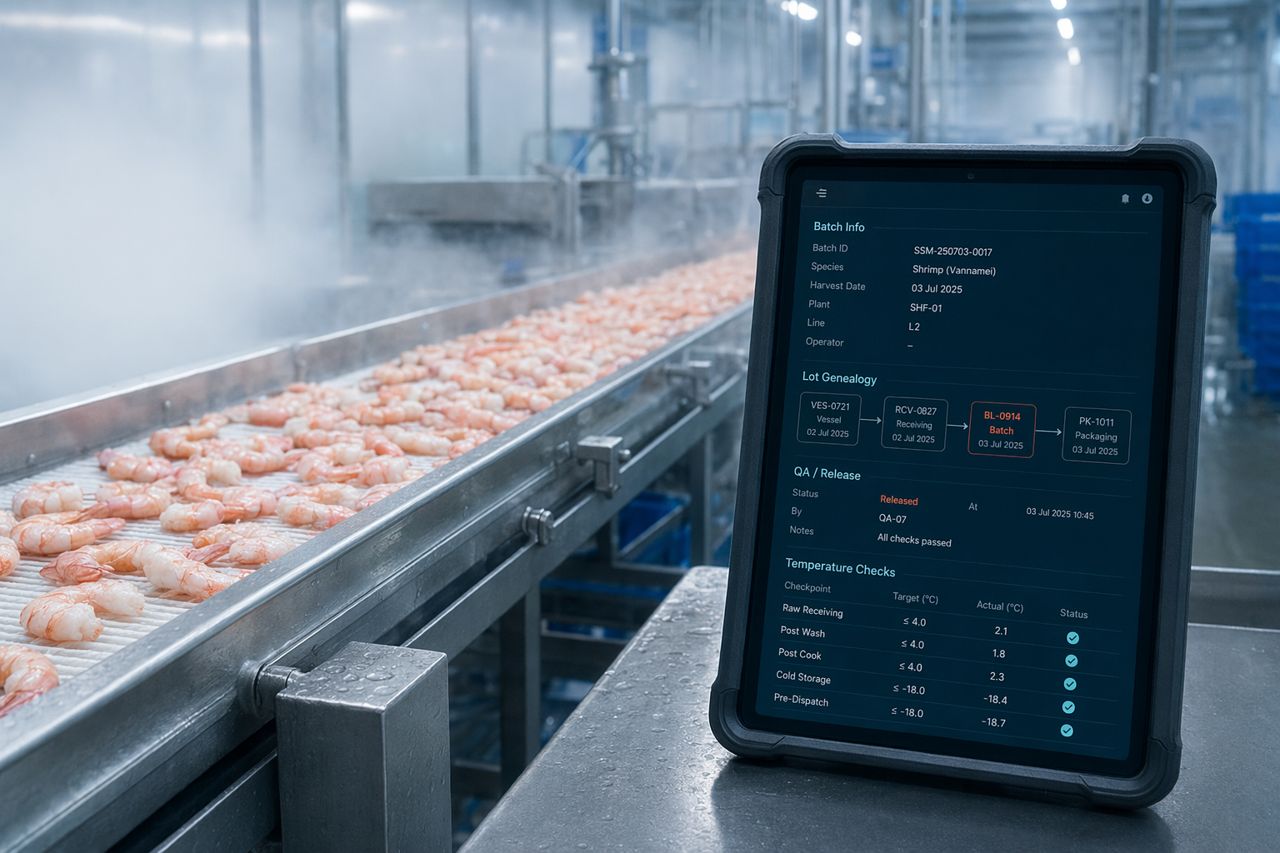
The record should connect every input to the finished lot. For enzyme-assisted shrimp peeling, this includes raw shrimp lot, ingredient or processing aid identity, internal item code, supplier lot, receiving date, storage condition, and authorized use location.
2. Process version
The batch record should show which approved process version was used. If a plant is comparing a standard peel process to an enzyme-assisted process, the record should clearly identify the version, approval status, effective date, and production line.
3. Time and temperature control
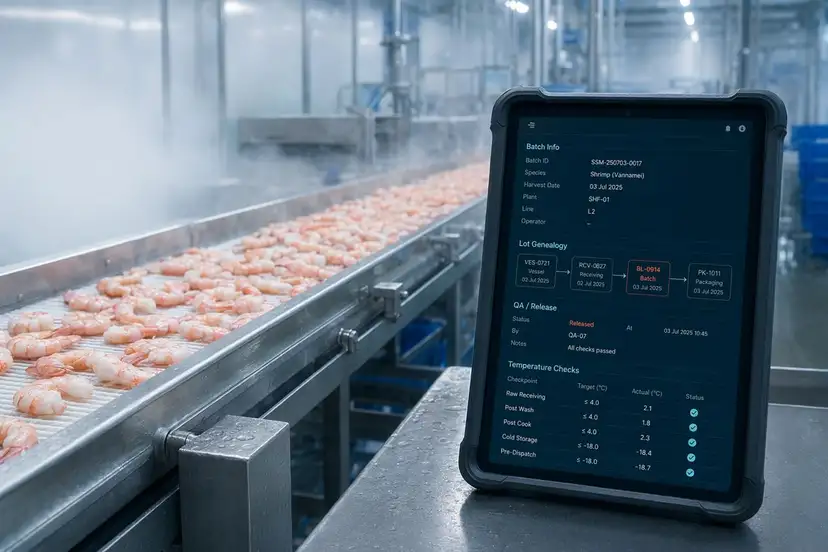
Cold-chain plants need proof that the product stayed within the approved process window. The record should capture the relevant temperature checks, hold points, corrective actions, and release status in a form that QA can review without reconstructing the shift from paper notes.
4. Operator and QA sign-off
Process changes fail when accountability is unclear. Batch records should identify who staged the material, who ran the step, who verified the check, and who released the batch.
5. Finished product link
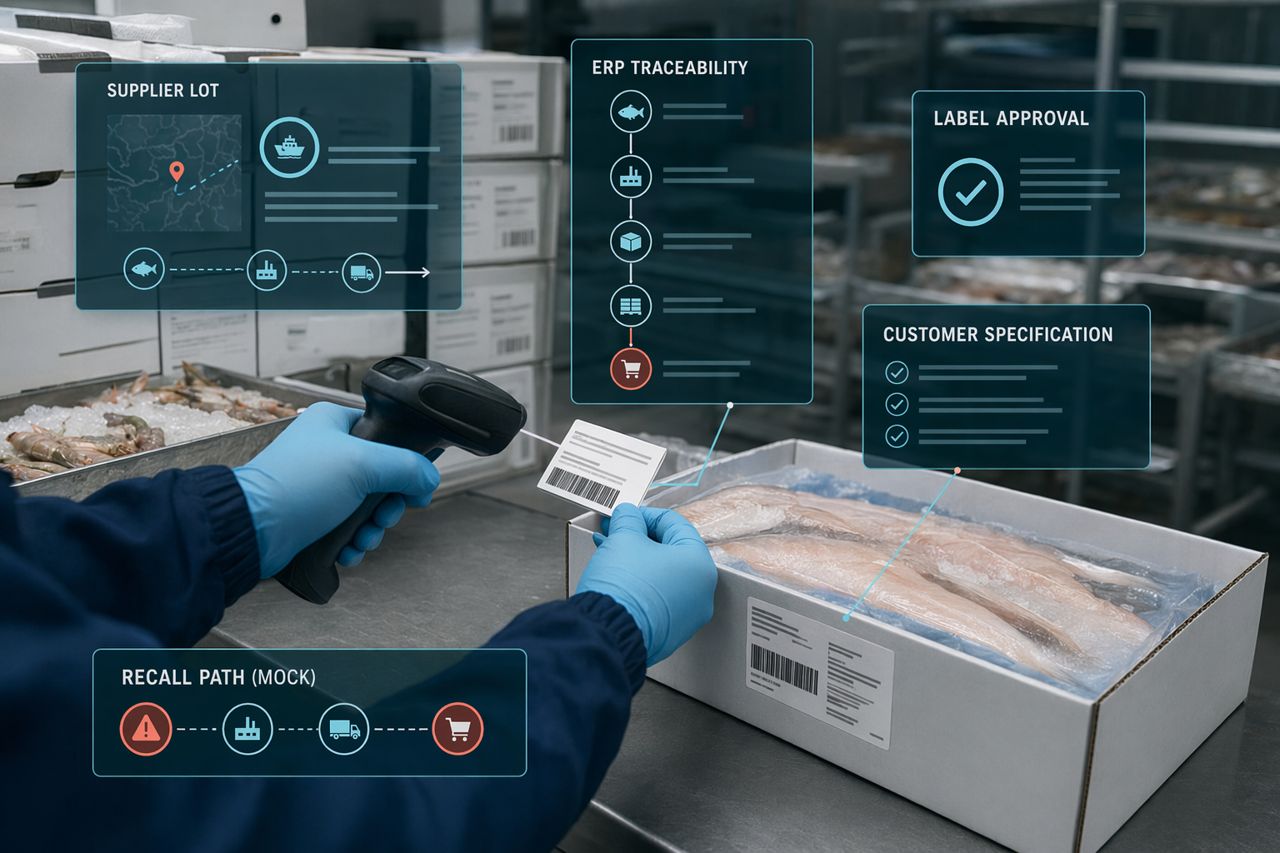
The record should connect the processing change to the finished product code, label, pack date, customer order, and shipment trace. This is essential for customer audits and mock recall speed.
ERP and traceability software considerations
ERP and QA software partners can make seafood process changes easier to control by treating process aids, trial variables, and QA approvals as structured data rather than free-text comments.
Useful system capabilities include:
- Lot-level linkage from raw material to finished shipment
- Controlled process versioning with approval workflows
- Ingredient and processing aid master data
- Configurable QA checkpoints for time, temperature, and visual quality
- Mobile-friendly production entries for cold-room use
- Deviation records tied directly to the affected batch
- Label approval and finished goods release controls
- Rapid mock recall reporting by customer, lot, date, or process version
The most effective systems reduce manual re-entry. If production staff must write the same lot number on a whiteboard, a paper batch sheet, and an ERP screen, the plant is creating unnecessary error points.
Label and customer specification impact
Before adopting any new seafood processing change, QA should confirm whether the change affects label language, customer specifications, certifications, or documentation packages.
Questions to review include:
- Does the customer require pre-approval for any process aid or ingredient change?
- Is the change limited to processing performance, or does it affect finished product declaration?
- Are country, retailer, or foodservice specifications more restrictive than internal standards?
- Does the certificate of analysis, specification sheet, or technical file need updating?
- Will export documentation or private-label documentation require revision?
For shrimp processors, this review should happen before the first commercial run. Waiting until after production creates release delays and can hold inventory in cold storage longer than planned.
Building a change-control packet for enzyme-assisted shrimp peeling
For a controlled plant trial or process conversion, Shellshift Marine recommends a concise change-control packet that QA, production, and procurement can all use.
Include:
- Business reason for change: labor reduction, peel consistency, reduced mechanical damage, yield protection, throughput stability, or customer quality target.
- Approved product and supplier data: item identity, supplier lot tracking, storage requirements, and handling instructions.
- Trial protocol: line, product type, process version, evaluation criteria, and hold points.
- Batch record template: required lot links, process checks, QA observations, deviations, and release sign-off.
- Quality evaluation: peel quality, appearance, texture, shell removal consistency, rework level, and downstream pack performance.
- Food safety and compliance review: HACCP or food safety plan impact, label review, customer approval status, and document control.
- Scale-up decision: acceptance criteria, corrective actions, training requirements, and effective date.
This packet helps the plant move faster because decision-makers are not arguing from memory. They are reviewing the same controlled record set.
Common documentation gaps to avoid
Cold-chain seafood plants often run into the same issues during process improvements:
- Trial batches are not tied to finished goods codes
- Supplier lot numbers are captured in receiving but not linked to production use
- Temperature checks exist, but not at the step where the process changed
- QA approval is verbal rather than recorded
- Customer approval is stored in email but not linked to the item master
- Labels are updated after production instead of before production
- Deviations are written separately from the affected batch record
- Operators are trained informally with no effective-date record
These gaps are avoidable when production, QA, procurement, and ERP administration align before the first live run.
What Shellshift Marine brings to the record
Shellshift Marine supplies enzyme solutions for shrimp peeling and seafood processing with the practical documentation support B2B plants need during evaluation and adoption.
We help technical and operations teams define the process change clearly, prepare supplier documentation, support trial planning, and align the enzyme step with batch records, QA checkpoints, and cold-chain handling practices.
The outcome is not just a better peel. It is a cleaner production record, faster internal review, less release friction, and stronger confidence when customers or auditors ask how the process is controlled.
Practical checklist for your next seafood process change
Before the next trial, confirm that your team can answer these questions:
- What exact process version is being tested?
- Which raw material lots and supplier lots are involved?
- Where is the enzyme or processing aid introduced?
- Which temperatures and hold points must be recorded?
- Who approves the batch before packing or shipment?
- Does the label, customer specification, or document package change?
- How will the batch be found in a mock recall?
- What data will determine whether the change scales to production?
If any answer is unclear, the batch record needs tightening before the plant scales the change.
Request a quote
Planning an enzyme-assisted shrimp peeling trial or updating seafood process documentation? Contact Shellshift Marine for a plant-floor discussion on process fit, documentation needs, cold-chain handling, and commercial supply.
Request a quote using the on-site form